Part 1 How I taught my grandmother to read chapter explanation class 9 Kaveri NEW NCERT CBSE 2026 27 art 1: How I Taught My Grandmother to Read – Detailed Explanation | Class 9 English CBSE 2026-27 | Kaveri Description: Welcome, students! 📚 Today we are starting a beautiful and heartwarming chapter, “How I Taught My Grandmother to Read” by Sudha Murty. In this video, we cover Part 1 of the story, explained strictly according to the New NCERT syllabus for the CBSE 2026-27 session. We will dive into the introduction of the young narrator and her grandmother, Krishtakka. We’ll explore their village life, their deep interest in the weekly magazine Karmaveera, the popular novel Kashi Yatre, and the emotional turning point that makes the grandmother realize the true value of being literate. What you will learn in this video: Detailed line-by-line explanation of the first half of the chapter. Important word meanings and vocabulary. The significance of the novel Kashi Yatre in the grandmother’s life. The emotional moment when the grandmother breaks down in tears. 📌 Ready for the next part? Watch Part 2 here: [Insert Link to Part 2 Video]
Reflect and Respond
I Complete the given word web.
Question: Why is it important to learn how to read and write?
Answers:
To gain independence
To build self-confidence
To gain knowledge
To stay connected
II Read the questions given below and share your answers with your classmates and teacher.
Question 1: Which language(s) do your grandparents or elderly relatives speak?
Answer: My grandparents primarily speak Hindi and Marathi. My grandmother also understands a bit of English, but she prefers speaking in her mother tongue when she is at home.
Question 2: How do they spend their time? How do you spend time with them?
Answer: My grandfather spends a lot of time gardening and reading the morning newspaper. My grandmother enjoys cooking and watching old classic movies. I spend time with them by helping in the garden or listening to stories about their childhood during dinner.
Question 3: What is your favourite experience with them?
Answer: My favorite experience is when my grandmother teaches me how to make traditional family recipes. It’s not just about the food; it’s the way she shares life lessons while we cook together.
Question 4: What is something that the elderly in your family cannot do easily but enjoy watching you do?
Answer: My grandparents find it difficult to use latest smartphone apps or play fast-paced video games, but they really enjoy watching me play or show them how a new piece of technology works. They are always amazed by how quickly my generation learns these things.
Vocabulary Matching
III Read the following passage. Match the highlighted words with their meanings given in the box below.
(i) protagonist — 7. main character
(ii) debate — 4. discussion
(iii) episode — 5. a part of a story
(iv) community — 3. people living in one particular area
(v) concentration — 6. focus
(vi) eagerly — 1. excitedly
(vii) convincing — 2. believable
(viii) guided — 8. directed
Check Your Understanding (Part I)
I Complete the cause and effect table given below based on Part I of the story. Share your answers with your classmates and teacher.
Cause 1: The transport system to the village was not very good.
Effect: (i) The morning papers arrived late in the day and weekly magazines would come one day late.
Cause 2: The grandmother, Krishtakka, never went to school.
Effect: (ii) She could not read on her own and had to depend on the narrator to read the story to her.
Cause 3: She identified herself with the novel’s protagonist because she too had a strong desire to visit Kashi but had never been.
Effect: (iii) Sheeply interested in the story and discussed it with her friends.
Cause 4: The narrator went to a wedding for a week.
Effect: (iv) The grandmother was left helpless without anyone to read the serial to her, which eventually brought her to tears.
Cause 5: In those days, education was not considered essential for girls (and she lost her mother at a young age).
Effect: (v) The grandmother never went to school.
Cause 6: The grandmother regretted not going to school.
Effect: (vi) She made sure that her children and grandchildren studied well.
II Questions:
Question: Do you think the narrator expected to see her grandmother in tears when she returned to the village? If yes, why? If no, why not?
Answer: No, the narrator did not expect to see her grandmother in tears. The text directly supports this: the narrator mentions, “I was surprised, for I had never seen her cry even in the most difficult situations.” Because her grandmother was usually a very strong and resilient woman, seeing her cry over something was completely unexpected and deeply worried the young narrator.
Question: iii) How might the narrator help her grandmother to fulfil her desire to learn to read and write?
Answer: To help her grandmother fulfill her desire to learn, the narrator could:
Become her teacher: The narrator can start teaching her grandmother the Kannada alphabet and basic vocabulary.
Set a routine: They could dedicate a specific time each day to practice reading and writing together.
Use the magazine as a goal: The narrator can use copies of Karmaveera (and the Kashi Yatre serial) as practical reading material to keep her grandmother motivated, with the ultimate goal being that the grandmother can read the next episode entirely on her own
Check Your Understanding (True or False)
I State whether the following sentences are true or false. Share your answers with your classmates and teacher.
Question: The grandmother wanted to learn the Kannada alphabet to gain independence. -> Answer: True
Question: The grandmother asked someone in the village to read Kashi Yatre to her while the narrator was away. -> Answer: False
Question: The narrator was the grandmother’s Orst teacher and taught her how to read Kannada. -> Answer: True
Question: The grandmother believed that there was no age limit for learning. -> Answer: True
Question: The grandmother touched the narrator’s feet as a mark of respect for her as a teacher. -> Answer: True
Question: The narrator was disappointed with the progress her grandmother made in learning to read. -> Answer: False
Critical Reflection
I Read the extracts given below and answer the questions that follow.
Extract 1 Questions:
(i) Question: Complete the following sentence with the appropriate option. The phrase ‘never seen her cry in the most di cult situations’ tells us that the grandmother was A. strong-willed B. understanding C. considerate D. bold
Answer: (i) A. strong-willed
(ii) Question: Complete the following with the correct option from those given in the brackets. Grandmother did not reply when the narrator asked if she was alright because she might have been too (emotional/tired) to respond.
Answer: emotional
(iii) Question: Identify the clue from the extract that indicates a rural setting with traditional customs.
Answer: The clues indicating a rural setting/traditional customs are sleeping on the “open terrace of our house” and the use of the regional word “Avva” for mother.
(iv) Question: Which lines of the extract establish a tender atmosphere?
Answer: The line establishing a tender atmosphere is: “Her affectionate hands touched my forehead.”
(v) Question: Which of the following aspect is NOT emphasised in the given extract? A. the emotional turmoil of the grandmother B. the alectionate bond between the narrator and her grandmother C. the grandmother’s regret over her lack of education D. the narrator’s concern for her grandmother
Answer: C. the grandmother’s regret over her lack of education (Note: This is revealed later in the story, not in this specific extract).
Extract 2 Questions:
(i) Question: What does the grandmother’s statement, “I want to be independent,” reveal about her character? A. She wanted to be literate. B. She desires self-su ciency. C. She wants to prove her intelligence to others. D. She feels pressured by society to learn.
Answer: B. She desires self-sufficiency.
(ii) Question: Fill in the blank with the appropriate option from those given in brackets. The grandmother’s determination shows that learning has no (age limit/gender bias/cultural barriers)
Answer: age limit.
(iii) Question: Complete the following with a suitable reason. The narrator laughs at her grandmother’s decision to learn the alphabet at the age of sixty-two because
Answer: The narrator laughs at her grandmother’s decision because she is sixty-two years old, has grey hair, wrinkled hands, wears spectacles, and spends most of her time working in the kitchen. It seemed childishly impossible to the young narrator.
(iv) Question: List any two qualities displayed by the grandmother.
Answer: Two qualities displayed by the grandmother: Determined and hardworking (or optimistic/humble).
(v) Question: How can we say that the narrator is making assumptions about her grandmother?
Answer: The narrator makes assumptions by associating old age and physical appearance (wrinkles, grey hair) with an inability to learn something new.
II Answer the following questions.
Question: Why do you think the grandmother felt embarrassed to ask someone else to read to her while the narrator was away?
Answer: She felt it was shameful to be a wealthy, respected adult who was entirely dependent on others just to read a magazine. It highlighted her illiteracy to the outside world.
Question: Why does the narrator initially laugh at her grandmother’s determination to learn at the age of sixty-two?
Answer: As a twelve-year-old, the narrator held the common societal stereotype that education is only for young children, not for sixty-two-year-old grandmothers who are busy with household chores.
Question: What significance does the story of Kashi Yatre have in both the grandmother’s life and the story?
Answer: The novel’s protagonist desires to visit Kashi for ultimate peace but sacrifices it for a noble cause. Similarly, the grandmother sacrifices her hesitation and comfort for the “good cause” of learning to read, which is her own personal pilgrimage to independence.
Question: What does the grandmother’s desire to learn the Kannada alphabet reflect about her?
Answer: It reflects her resilience, strong willpower, and belief that true independence comes from self-reliance and education, not just financial wealth.
Question: What lessons can we infer from the grandmother’s action of touching the narrator’s feet?
Answer: It teaches us that knowledge is sacred, and a teacher deserves immense respect regardless of their age or gender.
Question: What does the following line tell us about the broader theme of the story? ‘For a good cause if you are determined, you can overcome any obstacle.’
Answer: This line emphasizes that with strong willpower, a clear purpose, and hard work, societal barriers like age or missed opportunities cannot stop you from achieving your goals.
Question: How efectively does the story highlight the value of education in supporting personal independence?
Answer: The story effectively shows that even if you are financially well-off (“we are well-off”), you can still feel helpless without education. Literacy is portrayed as the true key to personal independence.
Vocabulary and Structures in Context
I Match the binomials in Column 1 with their meanings in Column 2.
1. sink or swim — (vii) succeed or fail without help
2. on and off — (v) sometimes, occasionally
3. mix and match — (i) put different things together to get a range of possibilities
4. all or nothing — (viii) something to be done completely or not at all
5. part and parcel — (ii) complete part of or belong to
6. pick and choose — (iii) choose only the best (things, people, etc.)
7. sooner or later — (iv) at sometime in the future
8. leaps and bounds — (vi) increase or develop very quickly
II Make words by adding the suitable prefixes given in the box to the words from the text in Column 1. Write the prefixed words in Column 2.
1. popular — (i) unpopular
2. belief — (ii) disbelief
3. important — (iii) unimportant
4. respect — (iv) disrespect
5. correct — (v) incorrect
6. continue — (vi) discontinue
7. understand — (vii) misunderstand
8. ordinary — (viii) extraordinary
9. interesting — (ix) uninteresting
10. possible — (x) impossible
III Identify any five words with prefixes from the story and make sentences using each.
Answers:
It is impossible to learn a new language without regular practice.
Please do not misunderstand my intentions; I only want to help.
Treating elders with disrespect is frowned upon in our culture.
Her performance on the stage last night was truly extraordinary.
The mechanic gave us incorrect information about the car’s (sentence cut off in source text)
IV Match the idioms related to ‘learning’ given in Column 1 with their meanings in Column 2.
1. to hit the books — (iii) to study seriously
2. to draw a blank — (v) to be unable to remember
3. to learn the ropes — (vi) to understand how to do an activity
4. to rack one’s brain — (ii) to think very hard
5. to learn by heart — (i) to memorise something
6. burn the midnight oil — (iv) to study or work late into the night
Now, use these idioms in sentences of your own.
Answers:
I need to hit the books this weekend because my finals are starting.
I tried to remember the author’s name, but I completely drew a blank.
It took me a few weeks to learn the ropes at my new job.
I had to rack my brain to solve the final puzzle.
My grandmother was able to learn by heart the entire story.
She had to burn the midnight oil to finish her science project on time.
Grammar & Listening Exercises
(i) Fill in the blanks with simple past and past perfect tense form of the verbs given in brackets.
A. Question: When the delegates _____ (arrive) at the conference, the keynote speaker _____ (already begin) the session.
Answer: When the delegates arrived at the conference, the keynote speaker had already begun the session.
B. Question: After the students _____ (learn) how to identify fake news online, they _____ (start) verifying information before sharing it.
Answer: After the students had learned how to identify fake news online, they started verifying information before sharing it.
C. Question: Before Kiran _____ (start) using digital payment platforms, she _____ (ensure) her understanding of online fraud prevention.
Answer: Before Kiran started using digital payment platforms, she had ensured her understanding of online fraud prevention
D. Question: By the time Varun _____ (recognise) the importance of budgeting, he _____ (exhaust) most of his savings.
Answer: By the time Varun recognised the importance of budgeting, he had exhausted most of his savings.
E. Question: When Raghu _____ (log in) to the cybersecurity webinar, the instructor _____ (already discuss) the importance of strong passwords.
Answer: When Raghu logged in to the cybersecurity webinar, the instructor had already discussed the importance of strong passwords
(ii) Fill in the blanks with the correct form of verbs given in brackets.
Question Paragraph: Last year, my parents and I A. _____ (take) a financial planning course. When we B. _____ (review) our expenses, we realised we C. _____ (spend) too much on unnecessary purchases. After my parents D. _____ (discuss) ways to save, I E. _____ (open) a savings account. By the time we F. _____ (set) our budget, the course G. _____ (already introduce) investment strategies. We H. _____ (hurry) to take notes, but many participants I. _____ (complete) their financial plans. Despite that, we J. _____ (enjoy) learning how to manage money wisely.
Answer Paragraph: Last year, my parents and I took a financial planning course. When we reviewed our expenses, we realised we had spent too much on unnecessary purchases. After my parents had discussed ways to save, I opened a savings account. By the time we set our budget, the course had already introduced investment strategies. We hurried to take notes, but many participants had completed their financial plans. Despite that, we enjoyed learning how to manage money wisely.
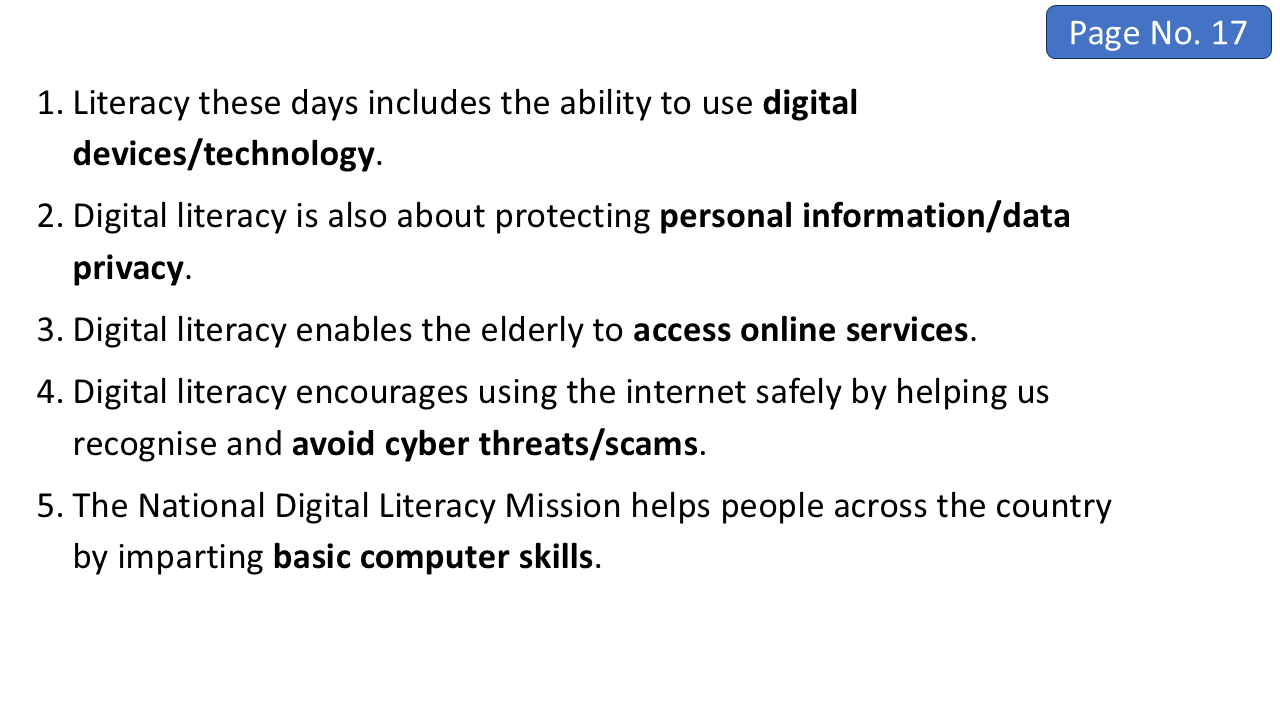
Listen and Respond I You will listen to a speaker talk about digital literacy. As you listen, complete the following sentences with one to three exact words that you hear.
Question: Literacy these days includes the ability to use _____
Answer: digital devices/technology.
Question: Digital literacy is also about protecting _____
Answer: personal information/data privacy.
Question: Digital literacy enables the elderly to _____
Answer: access online services.
Question: Digital literacy encourages using the internet safely by helping us recognise and _____
Answer: avoid cyber threats/scams.
Question: The National Digital Literacy Mission helps people across the country by imparting _____
Answer: basic computer skills.